
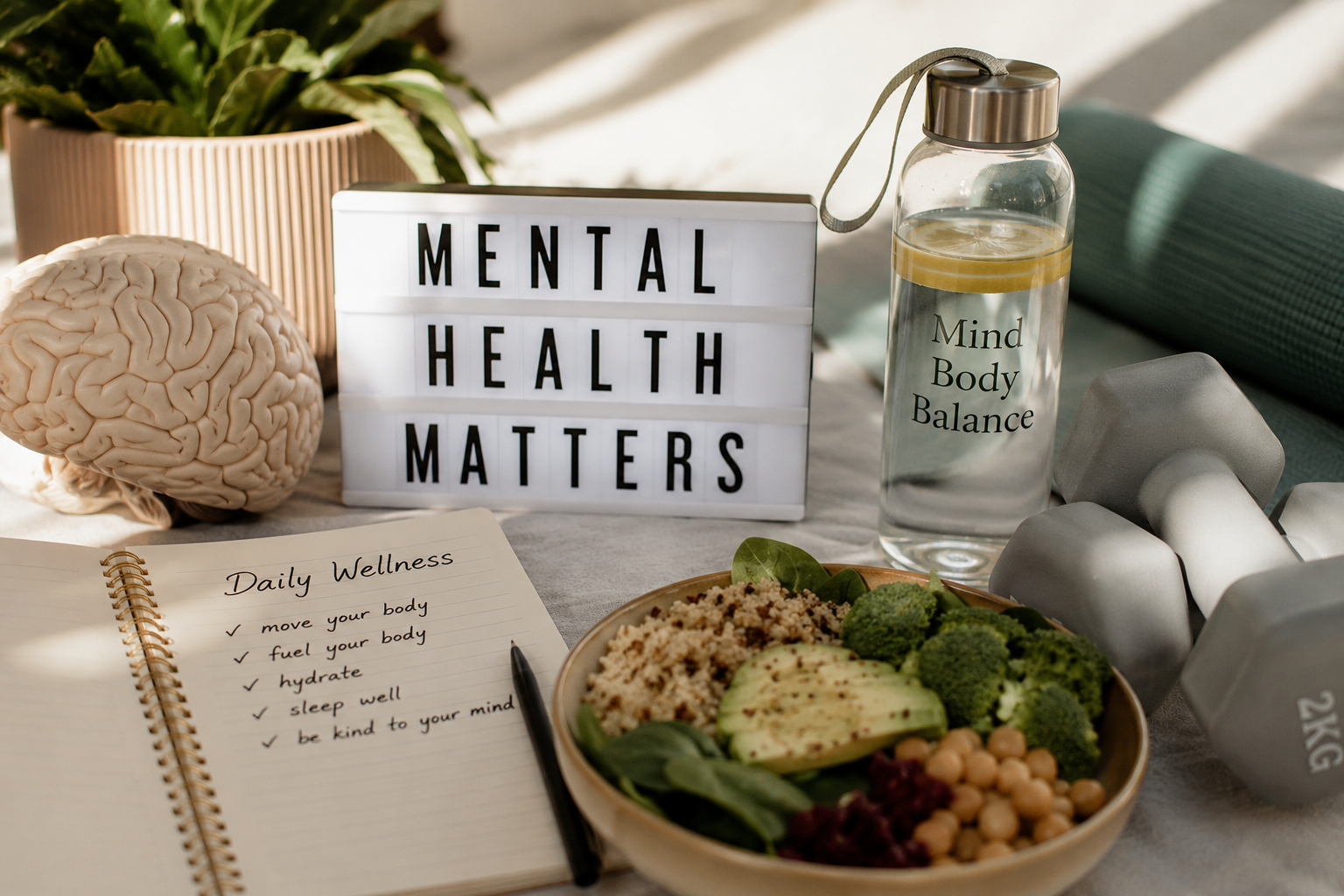
For years, mental health and physical health were treated as two separate conversations.
Today, neuroscience tells us a different story.
Your brain does not operate independently from the rest of your body. In fact, your sleep habits, nutrition, movement, stress levels, and daily routines directly influence how your brain functions, how you process emotions, and even how resilient you are during difficult seasons of life.
In other words: your lifestyle shapes your mind.
The Brain Loves Movement
One of the most fascinating discoveries in neuroscience is that exercise doesn’t just strengthen your body—it changes your brain.
Research has shown that physical activity increases levels of Brain-Derived Neurotrophic Factor (BDNF), often referred to as “fertilizer for the brain.” BDNF supports learning, memory, mood regulation, neuroplasticity, and the formation of new neural connections. Studies have consistently found that exercise is associated with improvements in cognition, mood, and overall mental well-being (Szuhany et al., 2015).
This helps explain why many people feel mentally clearer, more focused, and emotionally regulated after a walk, workout, Pilates class, or strength training session.
Movement isn’t just changing your body.
It’s changing your brain.
Neuroplasticity: Your Brain Is Always Adapting
One of the most exciting concepts in modern neuroscience is neuroplasticity—the brain’s ability to adapt, reorganize, and form new neural pathways throughout life.
The habits you repeat daily influence the pathways your brain strengthens.
Research suggests that regular physical exercise increases neuroplasticity, supports the production of neurotrophic factors, and contributes to improvements in brain function and cognitive performance (de Sousa Fernandes et al., 2020).
When you consistently move your body, challenge your mind, prioritize sleep, and engage in healthy behaviors, you’re not simply checking items off a wellness checklist. You’re actively supporting your brain’s ability to learn, adapt, and thrive.
Sleep Is Not a Luxury
Many people treat sleep as optional.
Your brain disagrees.
Neuroscience research has demonstrated a strong relationship between sleep and emotional brain function. Sleep plays a critical role in attention, memory, decision-making, emotional regulation, and overall cognitive performance (Goldstein & Walker, 2014).
In fact, sleep deprivation has been shown to increase negative mood states, decrease positive mood, and impair emotional regulation (Tomaso et al., 2020).
If you’ve ever felt more emotional, anxious, irritable, or overwhelmed after a poor night’s sleep, you’ve experienced this connection firsthand.
Sometimes what feels like a mindset problem is actually a recovery problem.
Food Fuels More Than Your Body
Your brain accounts for only a small percentage of your body weight, yet it consumes a significant amount of your daily energy.
The nutrients you consume influence neurotransmitter production, energy levels, concentration, and emotional regulation. While no single food will instantly transform your mental health, consistently nourishing your body provides the raw materials your brain needs to function optimally.
Wellness isn’t punishment.
It’s fuel.
Mental Health Is Built Through Daily Habits
When people think about improving their mental health, they often focus exclusively on changing their thoughts.
Thoughts matter.
But so do behaviors.
Exercise, quality sleep, proper nutrition, stress management, and meaningful social connection all influence brain health.
Research continues to demonstrate that physical activity positively impacts cognition, neuroplasticity, memory, emotional well-being, and overall quality of life (Mandolesi et al., 2018).
The goal isn’t perfection.
The goal is creating small habits that support your brain’s ability to thrive.
A daily walk.
A Pilates class.
A strength training session.
An extra hour of sleep.
A meal that fuels your body.
These choices may seem small, but your brain is responding to them every single day.
Final Thoughts
Health and wellness are not separate from mental health.
They are part of mental health.
The way we move, sleep, eat, recover, learn, and care for ourselves creates the foundation upon which our thoughts, emotions, and behaviors are built.
You don’t have to change everything overnight.
Start with one habit.
Then another.
And another.
Because a healthier brain is often built the same way a healthier life is built:
One intentional choice at a time.
References
Szuhany, K. L., Bugatti, M., & Otto, M. W. (2015). A meta-analytic review of the effects of exercise on brain-derived neurotrophic factor (BDNF).
de Sousa Fernandes, M. S., et al. (2020). Effects of Physical Exercise on Neuroplasticity and Brain Function.
Goldstein, A. N., & Walker, M. P. (2014). The Role of Sleep in Emotional Brain Function.
Tomaso, C. C., et al. (2020). The Effect of Sleep Deprivation and Restriction on Mood, Emotion, and Emotion Regulation.
Mandolesi, L., et al. (2018). Effects of Physical Exercise on Cognitive Functioning and Wellbeing.